
What Do You Do When Your Sponsor Cancels? Build Them a Better Reason to Stay.
Sponsorship sales rarely go in a straight line. One of the best examples from our own pipeline started with a cancelled call and ended with a campaign that outperformed anything a booth on the floor could have delivered.
The Setup
We were running sponsorship sales for one of our association conference clients, reaching out to prospective sponsors about what involvement in the event could look like for them. One sponsor, Klarify, an app built for therapists, responded early. Their founder wanted the Silver package and booked a call with us.
Then the call got cancelled.
The Choice
Here's the thing about a cancelled call: you can let it go, or you can find out why. We reached out, not just to reschedule, but to ask what happened.
The answer had two parts. A competing conference offered a better fit on paper, more attendees, a lower price point. And underneath that, a scheduling conflict he hadn't led with: he wouldn't be able to attend our client's event at all. He was getting married that week.
We asked for one more conversation instead of accepting that as the final answer.
The Pivot
On that call, we asked a different question: what if he didn't need to be on-site at all? We floated an idea, a sponsorship built specifically around his absence instead of in spite of it, priced to match the size and reach of the audience.
He liked it. He wasn't sold yet.
The Campaign
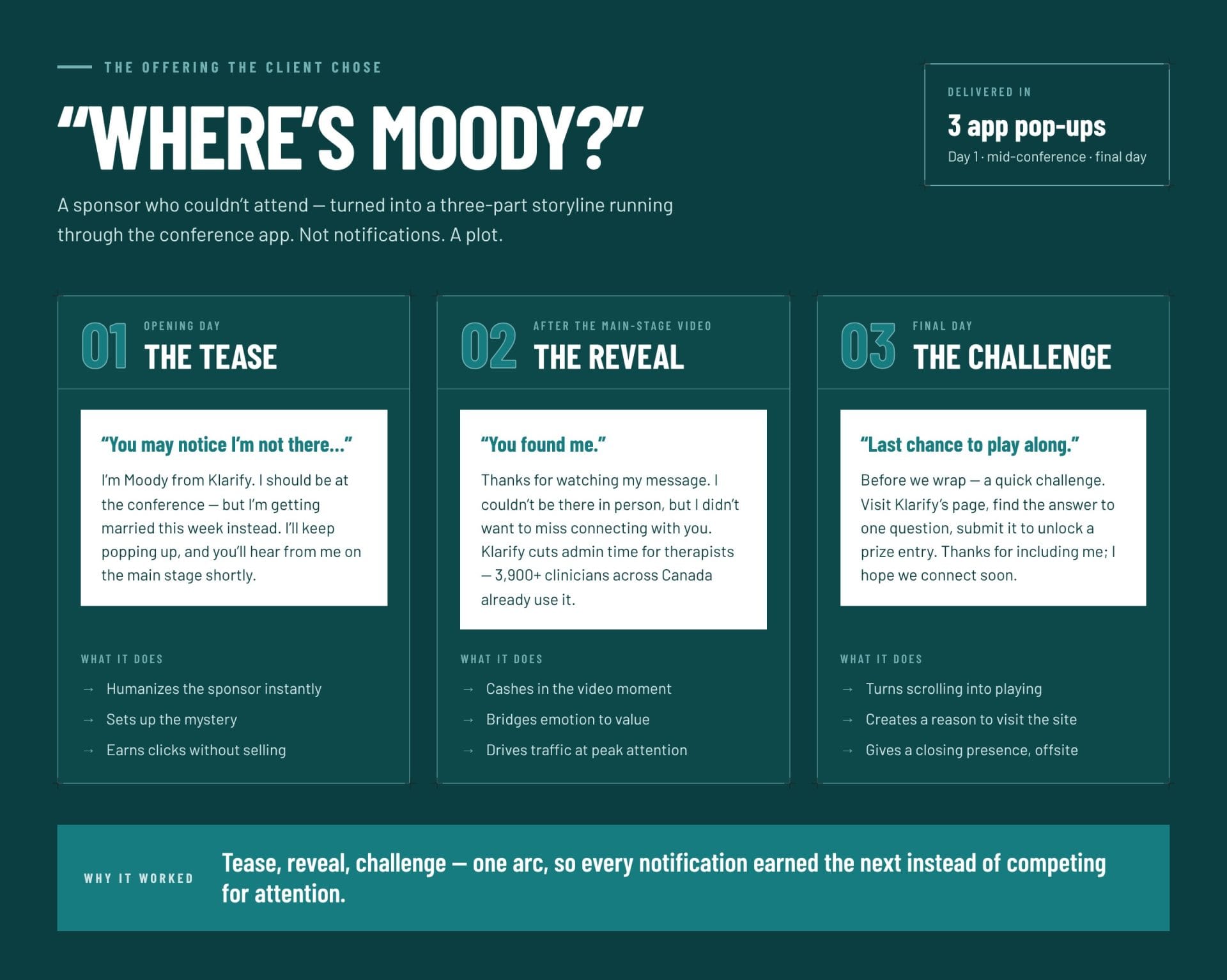
What we built was "Where's Moody?", a three-part interactive storyline delivered through the conference app instead of a booth.
On opening day, an app pop-up introduced him with a wink: he wasn't there in person, here's why, and here's what's coming. After his video played on the main stage, a second pop-up caught attendees right as their attention peaked, bridging the moment into what his company actually does. On the final day, a third pop-up turned a passive scroll into an active one, sending attendees to his website to find something specific, with a small reward for anyone who did.
No booth. No flight. No time away from his wedding.
The Result
The video played on-site. Within hours, his own tracking showed people landing on his website who'd never have found it otherwise. His reply said it plainly:
"I saw 100 people submitted the form already, that's incredible... I didn't expect it to be this popular, thanks again for suggesting this unique concept and helping make it happen."
What This Shows
A sponsor's first "no" is rarely the real objection. Klarify's founder wasn't rejecting the value of the conference, he was rejecting a format that didn't fit his reality that year. The fix wasn't a discount. It was a different shape entirely.
That's the difference between selling a fixed tier and building sponsorship around what actually gets a sponsor to a yes. If your association's sponsorship program is stuck on rigid packages that only work for sponsors who can show up in person, there's almost always a version that works for the ones who can't, and it can outperform the traditional model.
If your sponsorship revenue has plateaued or your prospects keep saying no for reasons you haven't fully dug into, let's talk about what a custom approach could do for your program.